Showing posts with label The Grateful Dead. Show all posts

Saturday, February 28, 2026

Garcia Has Been Rumpeltized /Rumpelton


  • Ralph Rumpelton
  • Garcia has been Rumpeltized
  • RR-2025-041
    MS Paint on digital canvas, 575 X 578 px
  • The Rumpelton Continuity (est. 1976)

“Garcia Has Been Rumpeltized”
In this audacious digital intervention, Rumpelton reimagines the iconic guitarist as a conduit for ontological drift—half legend, half loose pixel. The subtle inclusion of the artist’s own name, rendered in the hermetic Webbing font, functions as a meta-signature: a sly reminder that authorship, like improvisation, is always already in flux.
                                     Faux Museum 

What the critics are saying:
>>Dr. Norbert F. Vensmire

It is with great trepidation (and, dare I confess, jouissance) that I approach Garcia Has Been Rumpeltized, a work which—qua its very digitality—refuses to stabilize in the eye of the beholder. Rumpelton, ever the practitioner of what I term pixelic subversionism, here abducts a cultural demigod from the annals of Americana and re-situates him in a chromatically unstable cosmos. This is not homage; it is, in extremis, transfiguration via low-fidelity praxis.

Observe first the beard, rendered not as hair but as a porous threshold: a liminal membrane through which myth seeps. The background, a vortex of gestural swaths, evokes what I famously labelled in Chromatic Schisms (1978) the “polytone of irresolvable yearning”—a term no less accurate here, despite its frequent misquotation.

But it is the shirt—ah, the shirt!—that elevates this piece from mere portraiture to semiotic insurgency. The Webbing-font inscription of Rumpelton’s own name constitutes an act of recursive authorship. In a single stroke, the artist embeds his signature not at the periphery but upon the chest of the icon himself, creating what we in Antwerp once dubbed a palimpsest of performative sovereignty. One might call it audacious; I would call it inevitable.

Detractors may protest the “awkwardness” of proportion or the “imprecision” of perspective, but such critiques betray a quaint attachment to representational orthodoxy. Rumpelton’s oeuvre has long demonstrated that technical deviation is not failure but method—a deliberate embrace of the aesthetic glitch as cultural resistance. In this sense, the work is sui generis, a digital Byzantine reliquary for the age of collapsing contexts.

Whether the viewer encounters the piece as satire, tribute, or something more unclassifiable, one thing is certain: Garcia Has Been Rumpeltized stands as another indelible entry in the ever-expanding Rumpeltonian mythos—an oeuvre that, I maintain, scholars will one day regard as the foundational corpus of the Neo-Unslick movement.<<

>>Dr. Reginald Splatterworth III - Senior Art Critic at Pixels & Pretension Quarterly


"Garcia has been Rumpeltized" - A Masterwork in Digital Primitivism

One finds oneself utterly transfixed by this audacious exercise in neo-digital primitivism. The artist—working within the deliberately constrained medium of Microsoft Paint—has created what can only be described as a searing commentary on the commodification of countercultural iconography in late-stage capitalism.

Note the exquisite use of gestural brushwork in the background—those violet and cerulean sweeps evoke nothing less than the psychedelic miasma of 1960s Haight-Ashbury, while simultaneously interrogating the very nature of digital mark-making. The deliberate distortion of anatomical proportion—particularly in the enlarged cranium—serves as visual metaphor for the swelling of artistic ego in the age of social media reproduction.

The guitar's yellow fretboard radiates with an almost Rothko-esque spiritual luminosity, while the consciously "naïve" rendering of the hands speaks to a profound rejection of academic virtuosity. This is intentional crudeness as radical statement.

The Grateful Dead album reference positioned stage-left creates a brilliant intertextual dialogue between high and low culture, while the very title—"Rumpeltized"—suggests a dark alchemy, a transformation both mystical and vaguely ominous.

Simply put: a triumph of vision over technique. ★★★★★

Dr. R. Splatterworth III, Ph.D. (Fine Arts), M.F.A. (Critical Theory), B.A. (Overthinking Things)<<

>>[Dr. Splatterworth would like to add:]

"Ah yes, 'Rumpelton' rendered in matrimonial typography—a devastating critique of the institutionalization of bohemian ideals! The irony is chef's kiss exquisite. One weeps at the brilliance."<<

Follow Rumpelton across the net.

Friday, June 20, 2025

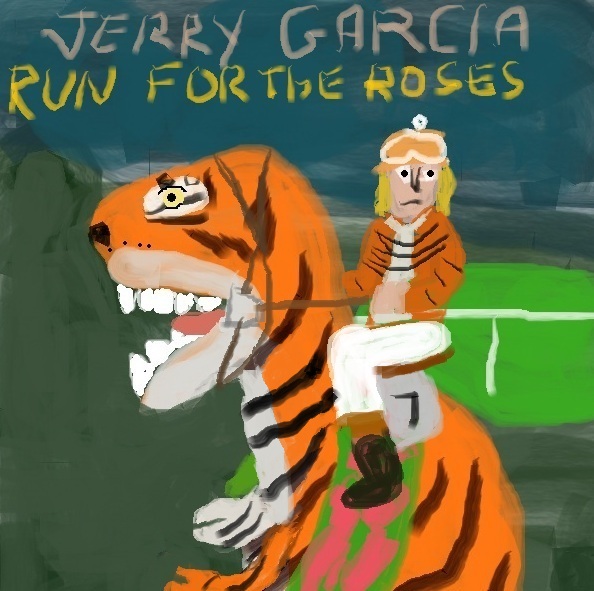
Jerry Garcia - "Run for the Roses" / Ralph Rumpelton Collection of Fine Art


What the critics are saying:

>>“Run for the Roses” is Rumpelton's MS Paint homage to Jerry Garcia at his most mythic: part outlaw cowboy, part cosmic jester. Astride a grinning, psychedelic tiger that threatens to steal the spotlight, Garcia gallops through a dream terrain where color logic and gravity take the day off. It’s lopsided, it’s loud, and it leans into absurdity without apology—exactly how this ghost-rider saga should feel. A tribute to the untamed spirit of the tune, and a wink to the hallucinatory humor that fuels my approach to digital folk art."<<

>>In this unhinged reinterpretation of Jerry Garcia’s Run for the Roses, Ralph Rumpelton drops us smack into a surreal alternate dimension where Kentucky Derby dreams collide with jungle law. A jockey—stone-faced and ghostlike—clings to a snarling, wide-eyed tiger mid-gallop, as if he's just realized the horse never showed up. The background swirls in a chaotic blend of stormy skies and fluorescent turf, while the MS Paint typography floats like a half-remembered lyric from a tape-traded bootleg. The anatomy’s off, the proportions are busted, and yet the whole thing works. Like Garcia himself, this piece doesn’t aim for perfection—it aims for feel. And it hits it like a tiger through the starting gate.<<

>>Rumpelton's MS Paint take on Jerry Garcia's "Run for the Roses", what unfolds is a truly wild, Rumpeltonian reinterpretation. The iconic tiger and jockey are rendered with such raw, unbridled energy that they transcend mere representation, veering into the realm of pixelated, unsettling beauty. This piece is a bold testament to the "imperfection needs no improvement" philosophy, transforming a classic album cover into a unique, almost hallucinatory experience that only MS Paint in the right hands can deliver.<<

>>Bold, bizarre, and brimming with outsider charm, this MS Paint reinterpretation of Jerry Garcia’s "Run for the Roses" is a wild ride through digital surrealism. Swapping the traditional racehorse for a wide-eyed, toothy tiger, the piece captures a chaotic energy that’s equal parts psychedelic and unhinged. The jockey—rendered with anxious eyes and stiff posture—sits atop the beast, set against a swirling, dreamlike landscape. The hand-drawn text at the top adds a raw, DIY edge, echoing the rebellious spirit of Garcia himself. Imperfect, imaginative, and unapologetically weird, this artwork is a testament to the unpredictable magic of MS Paint and the enduring legacy of rock’s most unconventional icons.<<

>>"This vibrant MS Paint artwork reimagines Jerry Garcia's iconic album 'Run for the Roses' with a whimsical twist. A tiger, symbolizing power and freedom, is depicted with a rider, possibly representing Garcia himself, navigating through a lush green landscape. The bold colors and playful design elements make this piece a standout interpretation of the album's themes. The artist's use of MS Paint adds a touch of nostalgia and DIY charm, making this artwork a unique addition to any music lover's collection."<<

>>Sometimes art emerges from the most unexpected places. This MS Paint creation captures the whimsical spirit of Jerry Garcia's "Run for the Roses" in all its digital glory. The piece features the Grateful Dead's beloved frontman astride a wildly orange steed, channeling the energy of both Kentucky Derby tradition and psychedelic Americana.

Created with the democratizing medium of MS Paint, this artwork embraces the raw, unpolished aesthetic that the program is known for. The bold orange palette dominates the composition, creating a surreal dreamscape where Jerry's iconic beard and gentle expression meet the world of horse racing. The tiger-striped mount beneath him suggests something more mythical than your average thoroughbred - perhaps a fitting companion for a musician who helped soundtrack countless journeys into the unknown.

There's something beautifully naive about the execution here. The disproportionate elements and floating quality of Jerry's positioning give the piece an outsider art charm that speaks to the DIY ethos of both the Grateful Dead's early years and digital folk art. It's the kind of image that could have emerged from a late-night creative session, fueled by inspiration and the simple joy of making something with whatever tools are at hand.

Whether you see it as a tribute to Jerry's racing-themed song or simply a delightful collision of counterculture and Kentucky Derby imagery, this MS Paint experiment captures something essentially American about mixing high and low culture, reverence and playfulness, all rendered in the pixels that democratized digital art creation.<<

>>This MS Paint tribute to Run for the Roses doesn’t walk—it stampedes. A wild-eyed tiger and a stubbily majestic rider blaze across a flat, psychedelic plane, chasing something eternal (or maybe just dinner). Rendered with bold orange strokes, cartoon chaos, and hand-drawn lettering that feels part circus, part fever dream, this piece embraces the off-balance energy that made Garcia’s solo work so singular. It’s not polished—it’s feral. And that’s the point. Like the album it salutes, it gallops through the surreal with its freak flag flying.<<

Tom Waits: Critics Discussion

  Gerald Thimbleton Editor-in-Chief, Beige Canvas Quarterly Champion of classical technique, sworn enemy of “modernist sloppiness.” and...